Private Label PHA Gluconolactone Serum
The exfoliation for skin that hates exfoliating — PHA's gentle resurfacing.
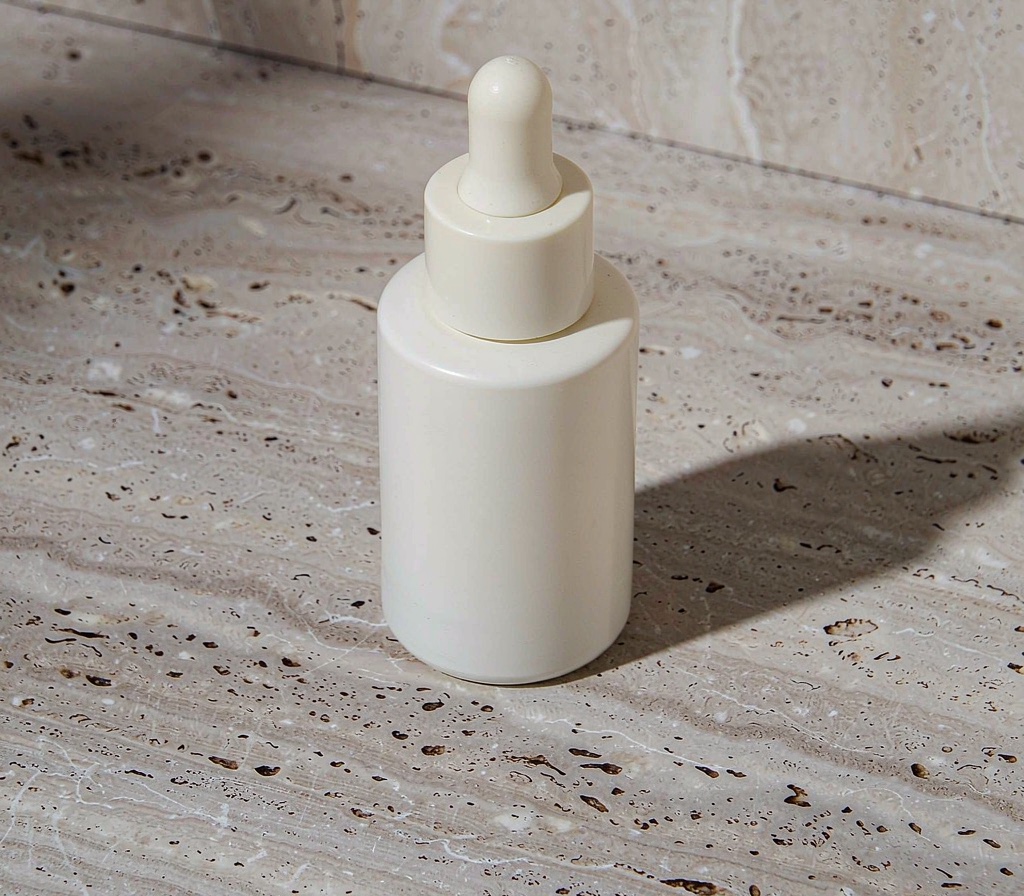
Where this formula can be adjusted
- 4% beginner vs. 8% experienced builds
- Patch-test data for sensitive claims
- pH documentation (3.8–4.2 window)
- Beginner-acids education insert
Questions we answer on every serum brief
PHA vs. AHA — why choose PHA?
Larger molecules penetrate slower, so sting drops while hydration stays. It is the entry acid and the sensitive-skin acid in one.
Can PHA be used daily?
Yes for most skins at 4–8%; we include titration guidance in your copy so customers ramp sensibly.
Does it need pH adjustment like AHAs?
It works in a similar acidic window; our QC holds pH through fill and shelf life with documentation.
Gluconolactone serum answers the customer who destroyed her barrier with AHAs: polyhydroxy acids exfoliate through larger molecules that penetrate slower, irritation drops dramatically, and humectant behavior stays on. 'The acid for sensitive skin' is a positioning that sells itself.
We run gluconolactone at cosmetic-standard 4–8% with lactobionic acid options for the premium builds, buffer with beta-glucan and panthenol, and validate the gentle claim with patch-test data your copy can cite.
Co-solvents buy solubility and charge for it
Adding a glycol or an alcohol widens what a water-based system can dissolve, and it is often the only way to carry a difficult active. The trade is that it also moves preservation, viscosity and how the product feels on skin.
Those side effects are consequences rather than surprises, and they are designed for from the start. Discovering them at the preservation study is where a launch schedule is usually lost.
Fluid bases and what each one can carry
Two fluids can look identical in the bottle and behave completely differently by the end of the shelf life.
| Route | Barrier it needs | Where it fits |
|---|---|---|
| Two-chamber or mix-at-use | Separated phases until activation | Actives that cannot hold a shelf life in solution |
| Preservative-light fluid | Airless or single-dose pack | Markets where the preservative profile is restricted |
| Structured gel | Chelator with no oil phase to protect | Treatment and gel-adjacent formats |
| Micellar system | Surfactant-stabilised, clear pack | Cleansing waters and no-rinse formats |
How a fluid is released, batch by batch
Filling runs in-house on GMPC and ISO 22716 certified lines under licence 粤妆20250206, with each batch traceable from raw material to carton.
Release reads the assay, the pH and the clarity, and compares the batch with the retained Golden Sample — colour and haze usually move before any assay reading does.
The actives and the levels they work at
INCI names and typical levels reflect publicly documented formulation practice. All values are adjustable in your build.
| Ingredient (INCI) | Typical Level | Function & Benefit |
|---|---|---|
| Gluconolactone | 4–8% | Gentle exfoliation + humectant |
| Lactobionic Acid | 2–4% | Premium PHA chelating support |
| Beta-Glucan | 0.5–1% | Calming buffer |
| Panthenol | 2% | Comfort reinforcement |
What holds this fluid together over its shelf life
Viscosity keeps building after fill
Polymer-thickened fluids can continue to develop structure for days after filling. Specification limits are written for the settled product, not for the freshly made one.
A buffer has a capacity
A buffer holds pH only across a limited range of incoming acid or base. Beyond that it gives way, so the capacity is checked against what the formula will actually meet rather than assumed.
Viscosity without heaviness
Fluids are thickened with polymers that leave no residue, because the texture is meant to disappear on application.
The dropper or the pump
Dispensing decides dose consistency and how much air the product meets in use. It is a formulation-adjacent choice, not just a packaging one.
Formats and order quantities
Mixed-variant orders can split the stated MOQ across formats under one brand.
| Format / Specification | MOQ | Lead Time |
|---|---|---|
| Gluconolactone 8% serum, 30 ml | 1,000 pcs | 10–15 days |
| PHA + lactobionic acid dual build, 30 ml | 1,000 pcs | 10–15 days |
| Gentle exfoliation set (PHA serum + toner) | 1,000 sets | 10–15 days |
MOQ and lead time above are the standard liquid, cream and gel route. The real minimum is set by the manufacturing system rather than the category: surfactant systems (shampoo, body wash) start at 2,000 pcs, stick formats at 3,000, and powders and sheet masks at 5,000 — with longer production runs to match.
Other fluid systems we manufacture
Private Label Exfoliating Toner
The daily-glow AHA toner — low enough for routine use, acidic enough to earn the claim.
Private Label Barrier Repair Serum
The post-exfoliation era's essential — lipid-identical repair in a serum texture.
Private Label Brightening Toner
Glow, applied by the palmful — the brightening routine's first pour.
Buyer guides for this build
Before you brief a supplier on this category, these are the guides that answer the questions buyers ask next — timelines, order quantities, cost structure and compliance.
How a fluid goes from brief to released batch
- 1
Run preservation and stability together
Both studies run against the finished matrix, across the temperature range of the destination market.
- 2
Screen solubility at the cold end
The batch is cooled to the coldest shelf it will meet and checked for haze, which is where an overloaded solubiliser system shows itself.
- 3
Adjust and hold the pH
pH is set with the buffer system and then held, rather than corrected repeatedly at the end of the batch.
- 4
Verify against the retained sample
Assay, pH and appearance are checked at release against the sample your buyer approved.
Send the product you are matching
If there is a serum whose texture you want to reproduce, send it. Reverse development rebuilds a comparable base, and your approved sample becomes the production reference.