Private Label Foam Cleanser
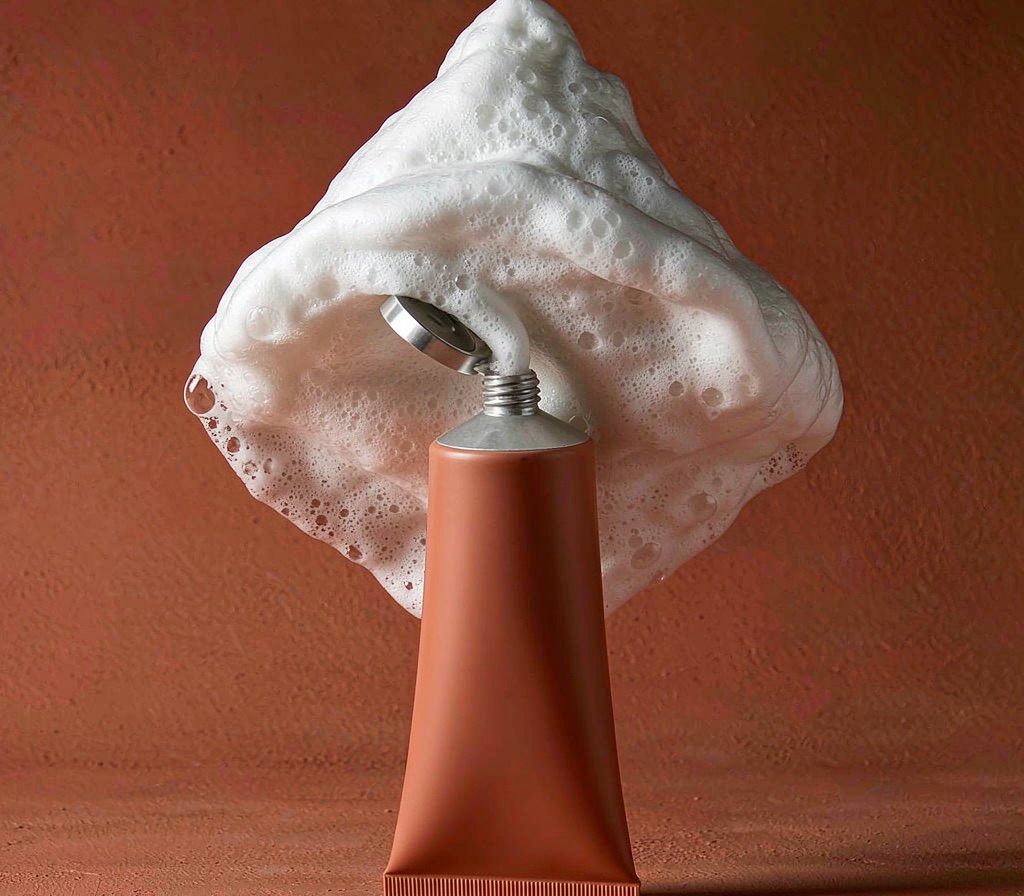
The satisfying middle ground — cream texture that whips into dense, cushioned foam.
Four things that decide how this washes
Preservation in a hostile base
A high-water, high-surfactant matrix is difficult for most preservative systems. The challenge is put to the preservation study rather than assumed from the raw materials.
Where the activity actually happens
Contact time is measured in seconds and the rinse dilutes everything. We dose for what remains on the surface instead of for the number printed on the front of the pack.
Fragrance in a rinse-off window
In a wash the scent has seconds to register. Fragrance load and encapsulation are set for impact at the moment of use, not for longevity on skin.
The lather question
Sugar-derived surfactants build foam more slowly and in finer bubbles. That reads as creamier rather than weaker, and it is a rheology problem before it is a surfactant one.
Foam cleansers win on experience: a cream that whips into dense cushioned foam feels like a spa step at home. Our systems keep that pleasure while holding pH 5.5 and gentle surfactants, so the 'squeaky clean' damage of old-school foams stays out of your reviews.
Two variants cover the market: acne-prone builds with salicylic acid traces and oil-control, and comfort builds with glycerin-panthenol for drier audiences. Pump-foam formats skip the lathering step entirely for convenience shoppers.
Foam is a signal, not a measurement
Customers read lather as evidence that the product is working, and the two are only loosely connected. A low-foaming system can clean as thoroughly as a high-foaming one — what changes is whether the customer believes it afterwards, which makes foam a sensory specification rather than a performance one.
So the foam target is set alongside the surfactant blend rather than after it. Flash foam, bubble density and how quickly the lather collapses are all measurable, and all three are quoted against the market the product is sold into.
Where each cleansing route fits
Two systems can reach the same position from opposite directions: one by softening the primary surfactant, one by adding a co-surfactant to cushion it.
| System | Lather character | Where it fits |
|---|---|---|
| Sulfate systems | High volume, instant foam | Value and clarifying tiers with no sulfate-free claim |
| Non-ionic-led | Very low foam, high mildness | Cleansers for reactive or post-procedure skin |
| Betaine-led blends | Generous foam at a lower raw-material cost | Mass-market and value briefs |
| Amino-acid systems | Soft, low-residue lather | Premium sulfate-free tier with a mildness position |
Other cleansing and care builds
Private Label Amino Acid Cleanser
The gentle-cleansing standard — pH-balanced surfactant systems that never leave skin tight.
Private Label Oil-Free Gel Cream
The lightweight everyday cream for oily and combination skin — matte finishes that layer clean.
Private Label Micellar Water
The no-rinse workhorse — gentle micelles for gym bags, travel and lazy nights.
Buyer guides for this build
Before you brief a supplier on this category, these are the guides that answer the questions buyers ask next — timelines, order quantities, cost structure and compliance.
Where this formula can be adjusted
- Tube, pump-foam or bottle formats
- Blemish or comfort variant systems
- Foam-density tuning for the sensorial demo
- Travel-size 30 ml add-on
The questions that come up every time
How is this different from an amino acid cleanser?
Overlap is large — foam cleanser describes the texture experience, amino acid describes the surfactant class. Our builds are both.
Does more foam mean more stripping?
Not with modern systems; foam density and mildness are independent variables, and we tune both separately.
Which variant for first launch?
Cream-to-foam comfort — it photographs well, suits the widest audience and pairs with any routine you build after.
The stages this wash passes through
- 1
Tune the sensory profile
Lather density, rinse feel and wet comb-out are assessed on the retained sample rather than described on paper.
- 2
Hold for microbiological release
The batch waits for its microbiological result rather than shipping against a pending one.
- 3
Set the rheology
Viscosity is built with electrolyte, polymer or both, then checked at the temperature the product will actually be stored at.
- 4
Assess the wet and dry feel
Lather, rinse and comb-out are assessed on the retained sample at release, since none of the three is captured by a number on the record.
Actives and the levels they work at
INCI names and typical levels reflect publicly documented formulation practice. All values are adjustable in your build.
| Ingredient (INCI) | Typical Level | Function & Benefit |
|---|---|---|
| Coco-Glucoside | 5–8% | Sugar-derived gentle foam base |
| Glycerin | 3–5% | Cushioning humectant |
| Salicylic Acid (trace) | 0.2–0.5% | Blemish-prone support |
Formats and order quantities for this wash
Mixed-variant orders can split the stated MOQ across formats under one brand.
| Format / Specification | MOQ | Lead Time |
|---|---|---|
| Cream-to-foam tube 120 ml | 1,000 pcs | 10–15 days |
| Pump foam 150 ml (no-lather-needed) | 1,000 pcs | 10–15 days |
| BHA foam for acne-prone 120 ml | 1,000 pcs | 10–15 days |
MOQ and lead time above are the standard liquid, cream and gel route. The real minimum is set by the manufacturing system rather than the category: surfactant systems (shampoo, body wash) start at 2,000 pcs, stick formats at 3,000, and powders and sheet masks at 5,000 — with longer production runs to match.
What a cleansing batch record carries
Production runs on GMPC and ISO 22716 certified lines in-house under licence 粤妆20250206, traceable from raw material to carton on every batch.
For a surfactant-led product the record pins the surfactant ratio, the viscosity reading and the pH at fill — the three numbers that decide whether the bottle behaves like the sample you approved. Everything is checked against the retained Golden Sample before release.
Bring the claim, we will bring the blend
Sulfate-free, colour-safe or value-tier foam — send the positioning and the pack size, and we come back with the system that holds it up.