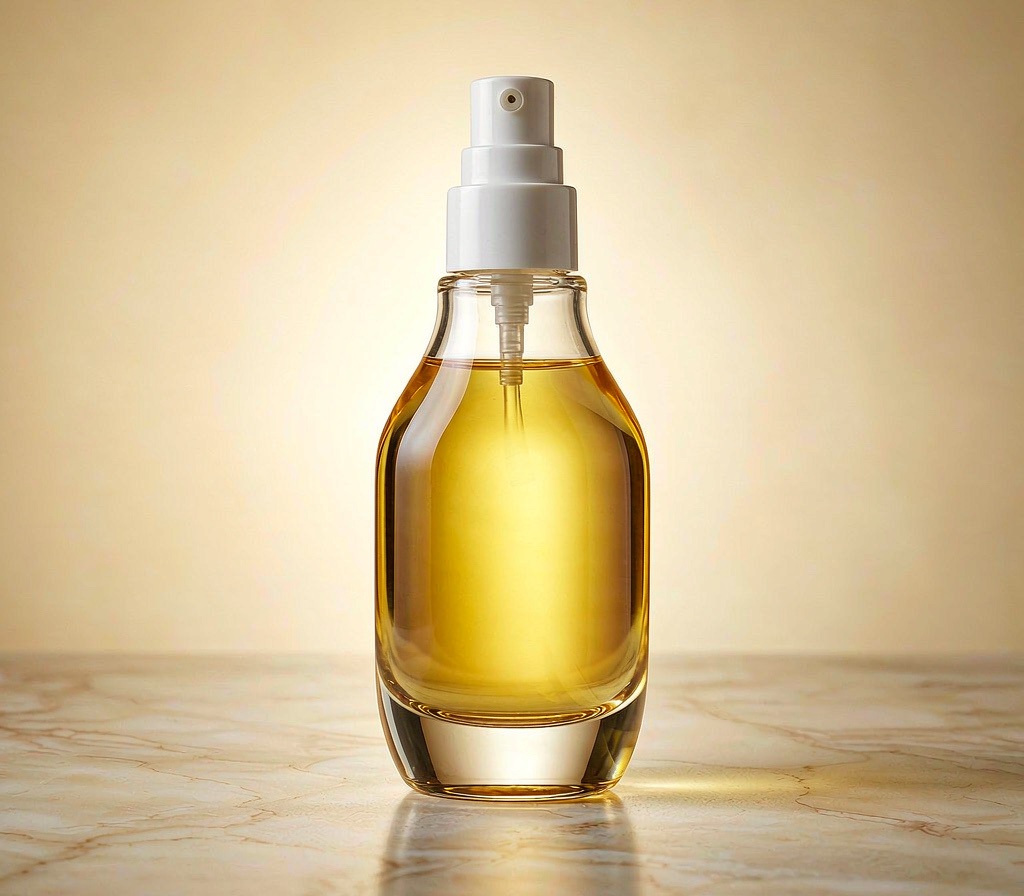
Private Label Hair Shine Spray
The finishing touch — one mist and the light finds the hair.
The questions that come up every time
Will it weigh hair down?
No — ester oils at low dose give reflection without the heavy silicone film; we verify on fine-hair swatches.
Why is the actuator so important?
A coarse spray wets hair and looks greasy; we source micro-mist heads and test pattern on black fabric before approval.
Clean-positioning friendly?
Yes — the plant-ester variant skips silicones entirely and remains the gloss driver.
Claim options and pack routes
- Fine-mist actuator sourcing
- Silicone-free system
- Glass or PET bottles
- Gift-set bundling
What decides whether this stays stable
Headspace oxygen
Air left in the bottle keeps reacting after fill. Low-oxygen filling removes most of the oxygen the product will ever encounter.
Both ends of the pack's life
An airless pack keeps the product away from air, but it also changes how the last few grams are dispensed. The end of the pack's life belongs in the design as much as the first.
Opaque is not a downgrade
Where an active is light-sensitive, an opaque or UV-filtered pack is part of the protection. Choosing clear glass for the look usually costs shelf life.
Compatibility between actives
Two actives that work alone can destabilise each other in the same bottle. Combinations are tested rather than assumed.
Shine spray is the last second of the styling ritual and the most photogenic SKU on the shelf: a fine mist of light oils and conditioning agents that adds gloss without weight or grease. It is also a pure impulse buy — small, pretty, priced to grab.
We build shine mists on light ester oils with fine-mist actuators (the spray pattern is the product), offer silicone-free plant-ester versions for clean-positioned lines, and keep the formula non-greasy so it layers over any finished style.
The actives and the levels they work at
INCI names and typical levels reflect publicly documented formulation practice. All values are adjustable in your build.
| Ingredient (INCI) | Typical Level | Function & Benefit |
|---|---|---|
| C13-15 Alkane (plant-derived) | 10–25% | Light-reflection ester |
| Caprylic/Capric Triglyceride | 5–15% | Gloss without weight |
| Tocopherol | 0.5% | Antioxidant polish |
In water, everything dissolves — including the problems
A water-based product is the simplest thing to make and the hardest thing to keep stable. Oxygen, light and trace metals all reach the actives directly, and there is no oil phase standing in the way to slow them down.
That is why protection here is built from three parts at once: the headspace, the pack and the chelation strategy. Remove any one and the shelf life falls to the weakest link in the chain.
Fluid routes and what each one has to protect
Each route below carries a different balance of preservative load, barrier requirement and sensory weight.
| Route | Barrier it needs | Where it fits |
|---|---|---|
| Micellar system | Surfactant-stabilised, clear pack | Cleansing waters and no-rinse formats |
| Concentrated serum gel | Airless pump to handle the viscosity | High-load actives sold on a small dose |
| Two-chamber or mix-at-use | Separated phases until activation | Actives that cannot hold a shelf life in solution |
| Preservative-light fluid | Airless or single-dose pack | Markets where the preservative profile is restricted |
Traceability from raw material to carton
Each batch is traceable from the incoming raw material through to the sealed carton, on GMPC and ISO 22716 certified lines operating under licence 粤妆20250206.
For a fluid the traceability record is read with the retained Golden Sample and the stability data, because colour, clarity and assay each move on their own timeline.
How the system is locked before scale-up
- 1
Adjust and hold the pH
pH is set with the buffer system and then held, rather than corrected repeatedly at the end of the batch.
- 2
Build the protection
Chelation, oxygen barrier and light barrier are decided together, because any one alone leaves the product exposed.
- 3
Validate the assay in the matrix
The analytical method is proven on the finished product before it is used at release, because a method written for the raw material often does not carry over.
- 4
Fix the active system
Routes and levels are set against the claim, then checked for compatibility with each other before the base is built.
Formats and order quantities
Mixed-variant orders can split the stated MOQ across formats under one brand.
| Format / Specification | MOQ | Lead Time |
|---|---|---|
| Shine spray 100 ml glass | 1,000 pcs | 10–15 days |
| Silicone-free plant-ester variant | 1,000 pcs | 10–15 days |
| Travel 50 ml | 1,000 pcs | 10–15 days |
MOQ and lead time above are the standard liquid, cream and gel route. The real minimum is set by the manufacturing system rather than the category: surfactant systems (shampoo, body wash) start at 2,000 pcs, stick formats at 3,000, and powders and sheet masks at 5,000 — with longer production runs to match.
Pair it with these builds
Private Label Hair Serum
The smoothing authority — film systems that shut down frizz in humid climates.
Private Label Glossing Treatment
The shine appointment, bottled — acidic gloss for glass-hair finishes.
Private Label Hair Perfume Mist
Fragrance made for hair — scent mists that condition while they perfume.
Buyer guides for this build
Before you brief a supplier on this category, these are the guides that answer the questions buyers ask next — timelines, order quantities, cost structure and compliance.
Tell us which active has to survive
Some actives dictate the entire base. Name the one that matters most and we build the protection around it.