Private Label Salt Body Scrub
The deep polish for rough zones — mineral salt scrubs for feet, elbows and pre-tan prep.
The route an exfoliant takes through production
- 1
Run the settling study
The product is held through the full stability window and checked for separation at the top and bottom of the pack.
- 2
Grade the particle
The particle is graded to a defined size band, because a wide spread reads differently on skin from a narrow one.
- 3
Select the particle against the market
Material, size and shape follow the destination market's restrictions first, then the feel the brief describes.
- 4
Fill under agitation
Filling runs with the bulk agitated so each unit receives the intended particle load rather than a settled fraction.
Exfoliants that pair with it
Private Label Body Scrub
The emulsified upgrade — scrubs that exfoliate, then turn into lotion in the shower.
Private Label Heel Repair Balm
The cracked-heel specialist — 25% urea balms in stick format that work between toes-adjacent minutes.
Private Label Foot Cream
The honest foot fixer — urea-intensive systems for callus, roughness and tired soles.
Buyer guides for this build
Before you brief a supplier on this category, these are the guides that answer the questions buyers ask next — timelines, order quantities, cost structure and compliance.
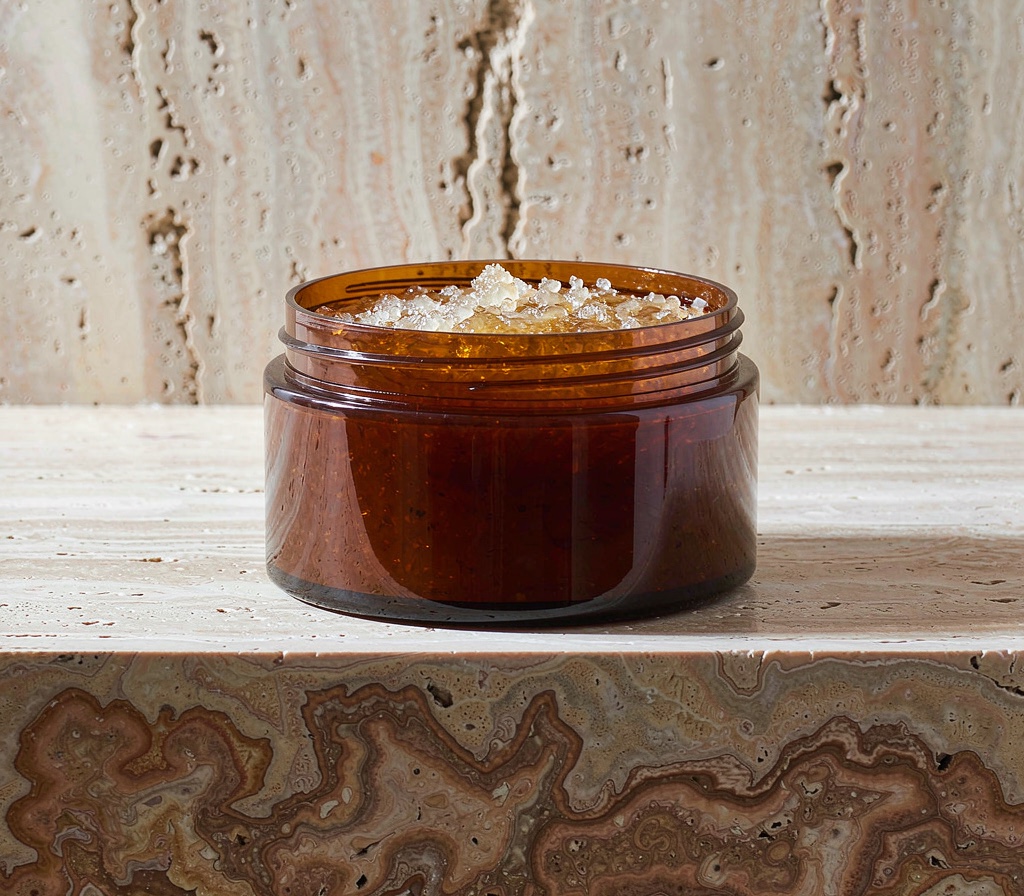
Salt body scrub is the heavy-duty polish: coarse mineral grains for the zones where skin genuinely calluses — heels, elbows, knees — plus the pre-tan-prep niche where smoothness is the whole point. Salt's osmotic grip also carries a mineral-spa story that sugar can't claim.
Oil-rich bases (15–30%) keep the salt working while cushioning skin, and rinse behavior matters: oil-flooded scrubs turn showers into hazards. Our systems balance oil load for polish without the bathtub risk, verified in rinse testing.
Particle, rinse and settling questions
Why not use salt on the whole body?
You can, but shaved or sensitive skin stings — the category splits: salt for rough zones, sugar for daily legs. Carrying both covers the household.
Is the oil phase a slip hazard?
Balanced systems emulsify on rinse; the oil-flooded versions that coat tubs are the ones that generate returns. We verify rinse behavior.
What is pre-tan prep?
Self-tanner grabs dry patches — polishing first is the beauty-community standard, a use case that makes this SKU seasonal-proof.
What a scrub batch record carries
Blending and filling run on GMPC and ISO 22716 certified lines in-house under licence 粤妆20250206, traceable from raw material to carton on each batch.
For a scrub the record carries the particle grade and size check, the fill weight per unit and the settling result from the stability study, alongside the material declaration for your destination market and the retained Golden Sample as the feel reference.
Pack formats, MOQ and lead time
Mixed-variant orders can split the stated MOQ across formats under one brand.
| Format / Specification | MOQ | Lead Time |
|---|---|---|
| Sea salt deep polish 300 ml jar | 1,000 pcs | 10–15 days |
| Foot-prep salt scrub 300 ml | 1,000 pcs | 10–15 days |
| Pre-tan prep scrub + moisturizer set | 1,000 sets | 10–15 days |
MOQ and lead time above are the standard liquid, cream and gel route. The real minimum is set by the manufacturing system rather than the category: surfactant systems (shampoo, body wash) start at 2,000 pcs, stick formats at 3,000, and powders and sheet masks at 5,000 — with longer production runs to match.
The particle and the base holding it
INCI names and typical levels reflect publicly documented formulation practice. All values are adjustable in your build.
| Ingredient (INCI) | Typical Level | Function & Benefit |
|---|---|---|
| Maris Sal | 40–60% | Mineral polish grains |
| Cocos Nucifera Oil | 15–30% | Cushioning oil phase |
| Menthol (foot edition) | 0.1–0.3% | Fresh finish signal |
Suspension is a stability problem in disguise
Particles are denser than the base they sit in, so a scrub that looks even at fill can settle into layers by the time it reaches the customer. Keeping them suspended is a rheology decision about the base, not a property of the particle.
That is why the viscosity specification for a scrub is written against settling behaviour across the shelf life rather than against a single bench reading.
Particle routes and the feel each one gives
Where a market restricts a material, the route changes rather than the claim — the polish is rebuilt on something else.
| Route | Feel and behaviour | Where it fits |
|---|---|---|
| Rounded beads | Gentle polish, even spread | Daily and sensitive-skin formats |
| Coffee grounds | Coarse, aromatic, heavy in the base | Body and foot formats sold on texture |
| Enzymatic polish | No particle at all, chemical action | Markets where any physical exfoliant draws scrutiny |
| Pumice | Hard, coarse, long-lasting | Foot and callus care |
Where this formula can be adjusted
- Grain coarseness by zone
- Foot and pre-tan positioning
- Rinse-safety verification
- Zone-targeted insert cards
What gets decided before the particle choice
Regulation moves faster than formulas
Several traditional scrub materials are restricted in major markets, so the particle is selected against the destination rulebook first.
Suspension aids versus clarity
The thickeners and yield-stress builders that hold particles up can also cloud a translucent base. Where clarity matters, the two are balanced deliberately.
Particles inside a surfactant base
In a cleansing scrub the particles sit within a surfactant matrix, which affects both suspension and how cleanly they rinse away.
Tub or tube
A tub invites finger contact with a water-rich product; a tube limits it. The pack changes the preservation strategy for the same formula.
Describe how aggressive it should feel
Gentle daily polish or a weekly treatment changes the particle grade. Send the intensity and we build the base around it.