Private Label Body Powder
Talc-free by design — the powder that made the category trustable again.
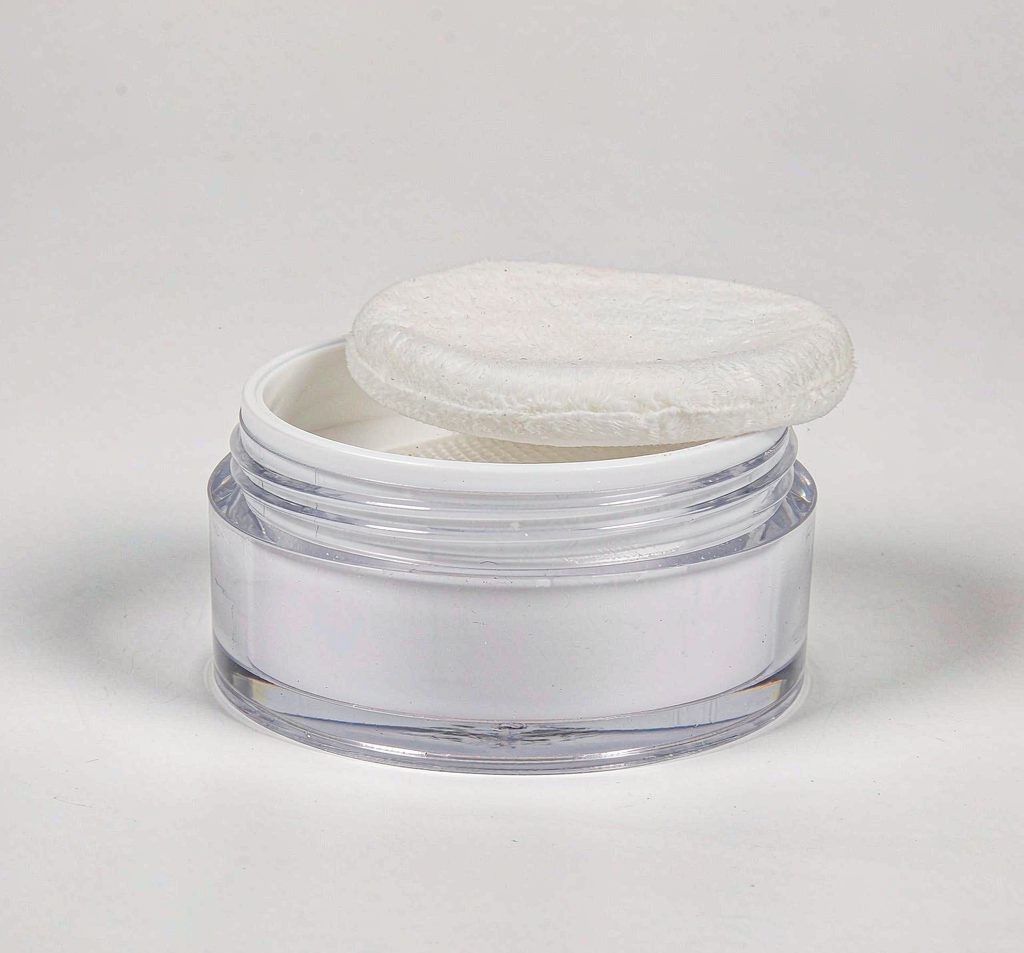
Body powder rebuilt itself around one word: talc-free. Cornstarch and arrowroot systems absorb moisture without the category's legacy controversy, and the modern customer reads the INCI — talc-free is not a variant, it is the product.
We build on finely-milled cornstarch with botanical scent loads, fill shaker and puff-top packaging, and serve both the self-care gifting lane and the sports-channel anti-chafe use case with one platform.
Where the compliance file comes from
The line is GMPC and ISO 22716 certified, and each batch carries raw-material-to-carton traceability under licence 粤妆20250206.
For a dry format the file is built on moisture control through milling, blending and filling, with the certificate of analysis, stability summary, microbiology report and MoCRA / CPNP-ready documentation attached to the order. Batches are released against the retained Golden Sample.
Flow, caking and shipping questions
Why talc-free?
Customer trust and retailer policy — many chains now require talc-free body powders. Our base is 100% talc-free with the documentation to prove it.
Clumping in humidity?
Milling spec and anti-caking blend handle tropical humidity; we ship-test to destination climate.
Sports channel fit?
Yes — the anti-chafe use case is the sport positioning; refill pouches suit gym retail.
Other dry formats we manufacture
Private Label Anti-Chafing Stick
The runner's secret, going mainstream — friction defense in a stick.
Private Label Feminine Wash
pH 3.8–4.5, extra-mild surfactants, and claims that survive scrutiny.
Private Label Foot Deodorant Spray
The problem nobody talks about, solved in one spray.
Buyer guides for this build
Before you brief a supplier on this category, these are the guides that answer the questions buyers ask next — timelines, order quantities, cost structure and compliance.
Formats and order quantities
Mixed-variant orders can split the stated MOQ across formats under one brand.
| Format / Specification | MOQ | Lead Time |
|---|---|---|
| Body powder shaker 100 g | 1,000 pcs | 10–15 days |
| Puff-top premium variant | 1,000 pcs | 10–15 days |
| Sport refill pouch 250 g | 1,000 pcs | 10–15 days |
MOQ and lead time above are the standard liquid, cream and gel route. The real minimum is set by the manufacturing system rather than the category: surfactant systems (shampoo, body wash) start at 2,000 pcs, stick formats at 3,000, and powders and sheet masks at 5,000 — with longer production runs to match.
How the blend is fixed before scale-up
- 1
Verify flow and appearance
Flow rate, colour and particle appearance are checked against the approved sample at release.
- 2
Set the particle specification
Size distribution is defined against the dissolution and flow the product needs, then held as a process parameter.
- 3
Hold for release on moisture
The batch is released on a moisture reading rather than on an assumption carried over from the raw materials.
- 4
Mill to a defined distribution
Milling runs to a particle size target rather than to a time, and the result is verified between batches.
The functional ingredients in this blend
INCI names and typical levels reflect publicly documented formulation practice. All values are adjustable in your build.
| Ingredient (INCI) | Typical Level | Function & Benefit |
|---|---|---|
| Zea Mays (Corn) Starch | 70–90% | Talc-free absorbency |
| Maranta Arundinacea (Arrowroot) Powder | 5–15% | Silky slip |
| Essential Oil blend | 0.3–0.8% | Botanical scent |
Grade, pack and inclusion options
- Talc-free standard
- Shaker / puff-top packaging
- Sport or gifting positioning
- Refill pouch economics
Blending is where a dry formula is won or lost
Two powders mixed together behave differently from either one alone. Density, particle shape and moisture all affect whether the blend stays uniform from the first scoop to the last.
That is why the blend is designed against segregation rather than checked for it afterwards, and why fill verification is done per unit rather than once per batch.
Which powder route fits which pack
Where a format reacts on contact with water, the pack and the moisture specification are part of the formula rather than an afterthought.
| Format | Process demand | Where it fits |
|---|---|---|
| Blended inclusions | Anti-segregation design | Botanical-led and gift-channel products |
| Low-dust agglomerate | Fewer fines, cleaner handling | Retail formats where dust draws complaints |
| Dry shampoo powder | Fine, low-residue, static control | Waterless hair-refresh formats |
| Granule | Size grading and dissolution tuning | Soaks, bath products and scooped formats |
Where a powder build succeeds or fails
Fragrance retention is harder here
Volatile notes escape a dry matrix more easily than an emulsion. Load and carrier are chosen against that loss.
Segregation of a blend
Different particle densities separate during shipping, so the blend is designed to still deliver a consistent dose at the bottom of the pack.
Bulk density versus fill weight
Settled and loose bulk densities differ, so a pack filled by volume can vary by weight. Fill is verified the way the customer experiences it.
Caking and anti-caking
Anti-caking agents are dosed against the humidity of the destination market, not written in as a fixed line.
Start from the pack size
Fill weight, barrier and shelf life all follow from the unit the customer buys. Send the pack and we build the blend around it.