Private Label Camellia Serum
The geisha's secret, cold-pressed — tsubaki's satin slip for dry seasons.
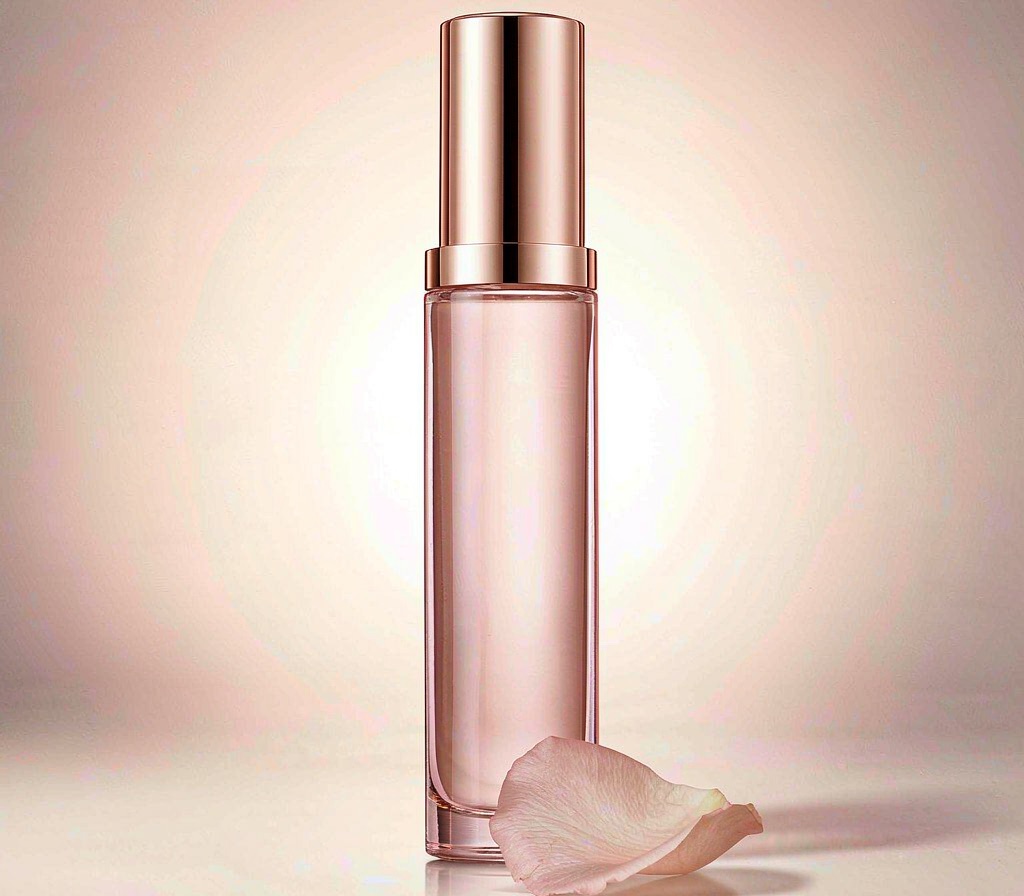
Camellia serum imports a centuries-old Japanese ritual: tsubaki (Camellia japonica) oil, the geisha-era hair-and-skin emollient with an unusually high oleic content and a fast, satin dry-touch unusual for oleic oils. It reads luxury without heaviness.
We cold-press and lightly filter to keep the pale gold color, offer pure single-oil or camellia-plus-squalane blends, and lean into the heritage packaging story — lacquer-red caps and minimal typography outperform clinical looks in this category.
What decides whether this stays stable
Chelation is dosed, not added
Too little chelator leaves trace metals free to catalyse oxidation; too much can undercut the preservation system or shift the pH. The level is set against the water and the raw materials.
Light is a reagent
UV accelerates the same reactions that heat does. Clear glass looks premium on a shelf and is usually the worst choice for a sensitive active.
The assay method is part of release
A method that works on the raw material can fail inside the finished matrix. It is validated against the product as filled before it is used at release.
Preservation in a water-rich base
High water activity calls for a preservation study against the finished matrix, not a calculation from the raw material list.
The stages this fluid passes through
- 1
Choose the pack
Airless, pump, dropper or tube — the format is selected for the viscosity and for the barrier it can provide.
- 2
Hold for microbiological release
For a fluid the microbiological result is often the last gate before filling, and the batch waits for it.
- 3
Set the pH window
The range is defined by the most sensitive active in the system, with a tolerance production can actually hold.
- 4
Flush the headspace
Where oxygen-sensitive actives are present, the headspace is displaced before the pack is sealed.
What you can change on this build
- Pure oil vs. blend builds
- Japanese heritage packaging direction
- Face + hair dual-positioning
- Cold-press COA with peroxide values
Formulas that sit beside this one
Private Label Camellia Hair Oil
The geisha's hair secret — tsubaki oil's featherweight gloss.
Private Label Rosehip Serum
The Chilean berry oil with a cult following — cold-pressed renewal in amber glass.
Private Label Squalane Serum
One ingredient, zero compromise — the oil that behaves like skin's own.
Buyer guides for this build
Before you brief a supplier on this category, these are the guides that answer the questions buyers ask next — timelines, order quantities, cost structure and compliance.
The functional system in this base
INCI names and typical levels reflect publicly documented formulation practice. All values are adjustable in your build.
| Ingredient (INCI) | Typical Level | Function & Benefit |
|---|---|---|
| Camellia Japonica Seed Oil | 50–100% | Oleic-rich satin emollience |
| Squalane | blend option | Lightweight slip extension |
| Tocopherol | 0.1% | Freshness protection |
Formats, pack sizes and MOQ
Mixed-variant orders can split the stated MOQ across formats under one brand.
| Format / Specification | MOQ | Lead Time |
|---|---|---|
| 100% camellia japonica seed oil, 30 ml | 1,000 pcs | 10–15 days |
| Camellia + squalane blend serum, 30 ml | 1,000 pcs | 10–15 days |
| Camellia face + hair oil duo | 1,000 sets | 10–15 days |
MOQ and lead time above are the standard liquid, cream and gel route. The real minimum is set by the manufacturing system rather than the category: surfactant systems (shampoo, body wash) start at 2,000 pcs, stick formats at 3,000, and powders and sheet masks at 5,000 — with longer production runs to match.
What brands ask us about this category
Camellia sinensis or japonica?
Different plants — sinensis is the tea leaf (antioxidant waters), japonica is the seed-oil tree (emollient serums). This SKU is japonica.
Will it feel heavy?
Counterintuitively no — tsubaki absorbs faster than argan in our feel panels; it is the 'lightweight luxury oil' of the category.
Can it serve hair too?
Yes — the Japanese heritage is hair-oil first; dual labeling expands your addressable routine.
Co-solvents buy solubility and charge for it
Adding a glycol or an alcohol widens what a water-based system can dissolve, and it is often the only way to carry a difficult active. The trade is that it also moves preservation, viscosity and how the product feels on skin.
Those side effects are consequences rather than surprises, and they are designed for from the start. Discovering them at the preservation study is where a launch schedule is usually lost.
Fluid bases and what each one can carry
The base is chosen around the least stable thing in the formula rather than around the headline ingredient.
| Route | Barrier it needs | Where it fits |
|---|---|---|
| Micellar system | Surfactant-stabilised, clear pack | Cleansing waters and no-rinse formats |
| Alcohol-based tonic | Simple pack, evaporating base | Oil-control formats and fast-dry tonics |
| Two-chamber or mix-at-use | Separated phases until activation | Actives that cannot hold a shelf life in solution |
| Structured gel | Chelator with no oil phase to protect | Treatment and gel-adjacent formats |
The paperwork that travels with a serum order
The lines are GMPC and ISO 22716 certified and operate in-house under licence 粤妆20250206, traceable from raw material through to carton.
Every production order ships with a certificate of analysis, a stability summary, a microbiology report and MoCRA / CPNP-ready documentation.
Because a fluid gives the actives nothing to hide behind, the retained Golden Sample is kept as the reference for colour and clarity, and the stability summary records how the system behaved across the destination market's temperature range.
Send the shelf life you need, not just the percentage
Tell us the market, the price tier and how long the product has to stay stable. We reply with the route that fits within 24 hours.