Private Label KP Body Treatment
The named-problem solution — AHA and urea systems for the arm-bump audience.
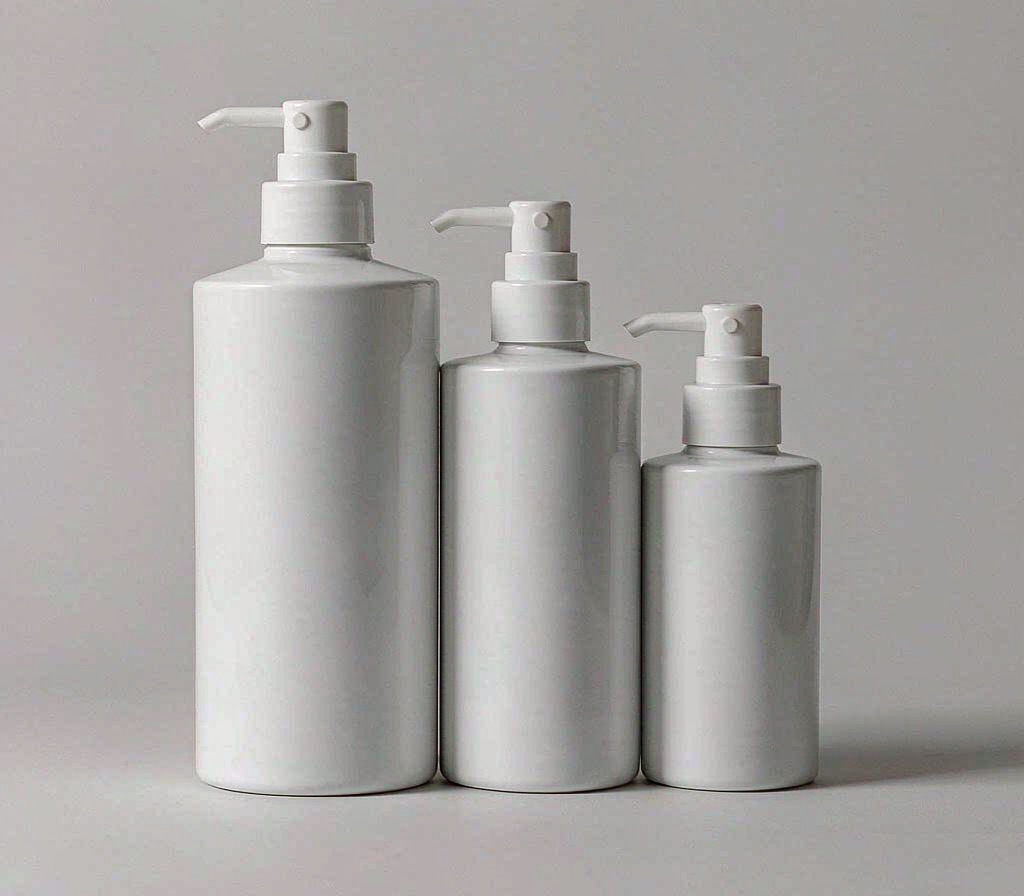
Every format this base can be filled in
Mixed-variant orders can split the stated MOQ across formats under one brand.
| Format / Specification | MOQ | Lead Time |
|---|---|---|
| KP smoothing lotion 10% urea + AHA, 300 ml | 1,000 pcs | 10–15 days |
| KP targeted serum 10% AHA, 100 ml | 1,000 pcs | 10–15 days |
| KP set: lotion + serum + exfoliating mitt | 1,000 sets | 10–15 days |
MOQ and lead time above are the standard liquid, cream and gel route. The real minimum is set by the manufacturing system rather than the category: surfactant systems (shampoo, body wash) start at 2,000 pcs, stick formats at 3,000, and powders and sheet masks at 5,000 — with longer production runs to match.
A fluid has nowhere to hide a mistake
In a cream a small inconsistency can read as texture. In a clear fluid every undissolved particle, every trace of haze and every shift in colour is on display, and the customer sees it before they use a single drop.
That is why filtration, water quality and raw-material checks carry more weight here than in any other format. Nothing in a transparent product stays invisible.
Fluid bases and what each one can carry
The base is chosen around the least stable thing in the formula rather than around the headline ingredient.
| Route | Barrier it needs | Where it fits |
|---|---|---|
| Emulsion-fluid hybrid | A light oil phase suspended in water | Slip and comfort without the weight of a cream |
| Biphasic | Two phases, shaken before use | Formats that need an activation step |
| Preservative-light fluid | Airless or single-dose pack | Markets where the preservative profile is restricted |
| Buffer-controlled fluid | Standard pack, tight pH control | Actives that only work in a narrow pH window |
Keratosis pilaris — those persistent arm bumps — has a named, searched community and a chemistry answer: AHA plus urea, the documented combination for softening keratin plugs. Naming the problem on the label converts a searching audience instantly, the most efficient marketing in body care.
Builds pair glycolic or lactic acid with 10% urea in lotions and targeted serums, with routine documentation (apply post-shower, daily, expect 6–8 weeks) that manages the honest timeline. Claims stay cosmetic — 'smooths the look of rough bumps' — and the community rewards the honesty.
Why a fluid is checked against a sample, not a number
Assay and pH tell you whether the chemistry is right; they do not tell you whether the product looks the way the buyer approved. Colour and clarity are read against the retained Golden Sample.
Production runs on GMPC and ISO 22716 certified lines under manufacturing licence 粤妆20250206, traceable from raw material to carton on every batch.
What gets decided before the preservative system
Opaque is not a downgrade
Where an active is light-sensitive, an opaque or UV-filtered pack is part of the protection. Choosing clear glass for the look usually costs shelf life.
Both ends of the pack's life
An airless pack keeps the product away from air, but it also changes how the last few grams are dispensed. The end of the pack's life belongs in the design as much as the first.
The pH window is narrower than solubility
The range where an active is stable is often tighter than the range where it dissolves. Both ends are verified at fill rather than assumed.
Viscosity without heaviness
Fluids are thickened with polymers that leave no residue, because the texture is meant to disappear on application.
Build the routine around it
Private Label Brightening Body Lotion
Face-grade brightening, body-scale — niacinamide systems for even tone below the neck.
Private Label Body Serum
Treatment-grade care below the neck — leave-on serums for the body concerns lotions ignore.
Private Label Azelaic Acid Serum
The gentle multitasker for tone and texture — suspension chemistry done right.
Buyer guides for this build
Before you brief a supplier on this category, these are the guides that answer the questions buyers ask next — timelines, order quantities, cost structure and compliance.
From brief to released fluid, step by step
- 1
Verify dosage across the pack
Where the pack meters a dose, the delivered volume is checked across the life of the pack rather than only when it is full.
- 2
Validate the assay in the matrix
The analytical method is proven on the finished product before it is used at release, because a method written for the raw material often does not carry over.
- 3
Screen solubility at the cold end
The batch is cooled to the coldest shelf it will meet and checked for haze, which is where an overloaded solubiliser system shows itself.
- 4
Choose the pack
Airless, pump, dropper or tube — the format is selected for the viscosity and for the barrier it can provide.
Claim options and pack routes
- Lotion and targeted-serum formats
- Routine-timeline insert packs
- Exfoliating-mitt set bundles
- Community-focused claim wording
Questions we answer on every serum brief
Why does naming KP on the label matter?
The audience searches 'KP' and 'arm bumps' specifically — named positioning converts that search instantly, better than any generic smoothing claim.
How long until results?
6–8 weeks is the honest documented window; the insert card setting that expectation is what protects reviews on a product that genuinely works slowly.
Is AHA safe on arms daily?
At cosmetic doses with barrier support, yes — and the routine documentation includes irritation-stop guidance for responsible use.
The actives and the levels they work at
INCI names and typical levels reflect publicly documented formulation practice. All values are adjustable in your build.
| Ingredient (INCI) | Typical Level | Function & Benefit |
|---|---|---|
| Glycolic Acid | 5–10% | Keratin-plug dissolution |
| Urea | 10% | Softening keratolytic |
| Ceramide NP | 0.2% | Barrier comfort offset |
Bring the claim and the climate
Where the product will be stored decides the barrier. Send the destination market and we quote against it within 24 hours.