Private Label Foot Scrub
The middle step of the foot ritual — grit that earns its scent.
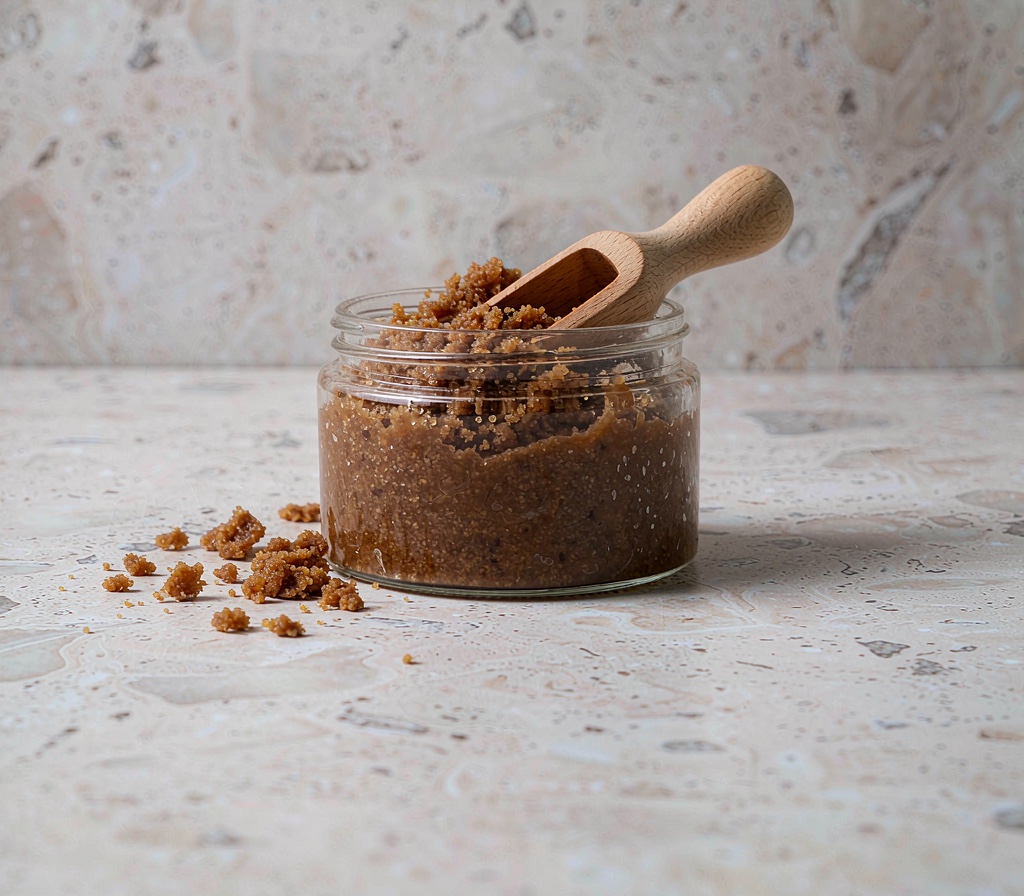
What the scrub is built from
INCI names and typical levels reflect publicly documented formulation practice. All values are adjustable in your build.
| Ingredient (INCI) | Typical Level | Function & Benefit |
|---|---|---|
| Pumice (fine grade) | 10–20% | Mechanical exfoliation |
| Maris Sal | 20–40% | Mineral grit and cleanse |
| Mentha Piperita (Peppermint) Oil | 0.3–0.8% | Cooling signature |
Foot scrub sits in the ritual middle: after the soak softens, before the balm seals. Pumice and salt grits do the mechanical work while peppermint does the sensory selling — the product whose use is a demo and whose jar lives by the basin.
We balance pumice fineness for effective-but-comfortable abrasion, load the peppermint cooling that makes it feel professional, and package in wide-mouth jars that suit basin-side use — plus salon back-bar sizes.
Where the compliance file comes from
The line is GMPC and ISO 22716 certified, and each batch carries raw-material-to-carton traceability under licence 粤妆20250206.
For an exfoliating format the file is built on the particle declaration, the fill weight and the settling result, with the certificate of analysis, stability summary, microbiology report and MoCRA / CPNP-ready documentation attached. Batches are released against the retained Golden Sample.
Where an exfoliant build succeeds or fails
Tub or tube
A tub invites finger contact with a water-rich product; a tube limits it. The pack changes the preservation strategy for the same formula.
Fill accuracy with solids
Suspended solids can stratify during filling, so the line is run to keep the dose per unit consistent from first to last.
Particle shape sets the feel
Rounded beads polish, irregular particles exfoliate harder. The choice follows the brief and is confirmed on the approved sample.
Foam inside a scrub
A surfactant-rich base foams as it is worked in, which changes how the particles feel. Foam level is tuned alongside the particle, not separately.
From brief to released scrub, step by step
- 1
Select the particle against the market
Material, size and shape follow the destination market's restrictions first, then the feel the brief describes.
- 2
Fill under agitation
Filling runs with the bulk agitated so each unit receives the intended particle load rather than a settled fraction.
- 3
Hold for settling release
The batch is read against the settling result before it is released for filling.
- 4
Verify filling accuracy
Net weight and particle distribution are checked per unit, since suspended solids can stratify during filling.
What you can change on this build
- Grit-grade tuning (fine/regular)
- Wide-mouth jar packaging
- Salon back-bar sizes
- Ritual-kit bundling
Two particles that read the same on paper feel different on skin
Shape, size and hardness each contribute to the exfoliation a customer perceives, and they interact with one another. A harder particle in a fine grade can feel gentler than a softer particle in a coarse one.
That is why the grade is selected against a reference product rather than against a specification sheet alone, and why the reference is kept as part of the approved sample.
Which exfoliant fits which market
Each route below changes the feel, the rinse behaviour and the documentation that has to travel with the order.
| Route | Feel and behaviour | Where it fits |
|---|---|---|
| Rounded beads | Gentle polish, even spread | Daily and sensitive-skin formats |
| Oat and grain particles | Soft, irregular, gentle in use | Sensitive-skin and facial polishes |
| Enzymatic polish | No particle at all, chemical action | Markets where any physical exfoliant draws scrutiny |
| Wax beads | Melt during use and leave no residue | Formats built on a self-dissolving particle |
Other exfoliating formats
Buyer guides for this build
Before you brief a supplier on this category, these are the guides that answer the questions buyers ask next — timelines, order quantities, cost structure and compliance.
What brands ask us about this category
Pumice or salt grit?
Both in the standard — pumice for even abrasion, salt for dissolve-away finish. Fine-grit variant suits sensitive and elderly customers.
How does it pair with the soak?
Soak softens, scrub removes, balm seals — the three-step story is the ritual kit and each step justifies the next.
Salon channel sizes?
Yes — 1 kg back-bar tubs from 1,000 pcs, the size professionals actually finish.
Every format this base can be filled in
Mixed-variant orders can split the stated MOQ across formats under one brand.
| Format / Specification | MOQ | Lead Time |
|---|---|---|
| Foot scrub jar 250 g | 1,000 pcs | 10–15 days |
| Fine-grit sensitive variant | 1,000 pcs | 10–15 days |
| Salon back-bar 1 kg | 1,000 pcs | 10–15 days |
MOQ and lead time above are the standard liquid, cream and gel route. The real minimum is set by the manufacturing system rather than the category: surfactant systems (shampoo, body wash) start at 2,000 pcs, stick formats at 3,000, and powders and sheet masks at 5,000 — with longer production runs to match.
Describe how aggressive it should feel
Gentle daily polish or a weekly treatment changes the particle grade. Send the intensity and we build the base around it.